
Some 2025 and 2026 vehicles already require the new standard, which becomes mandatory in 2027.
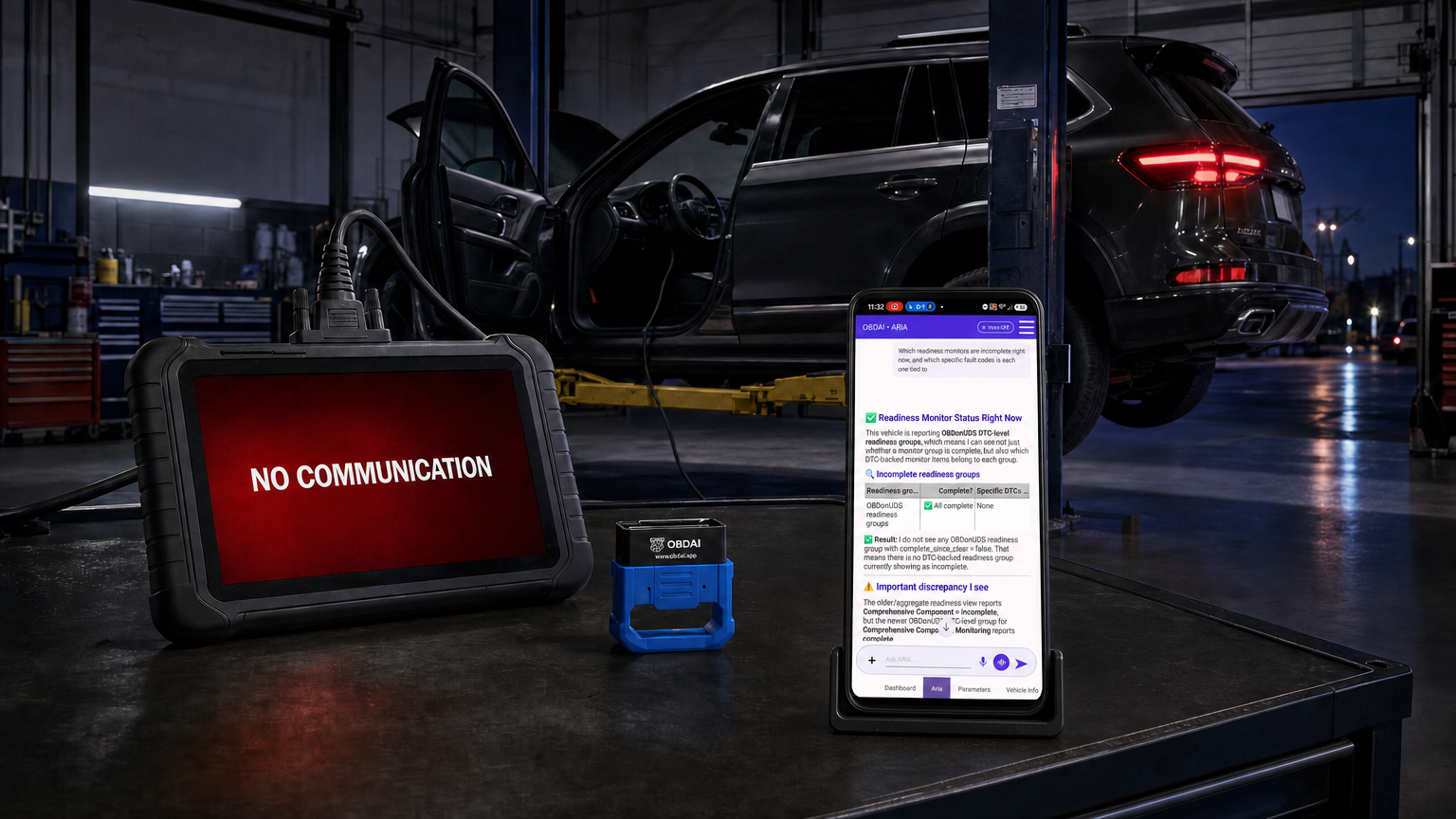
WHY THE CAR LEAVES YOUR SHOP The scan tool reports No Communication—or returns only part of the standardized powertrain record. You cannot finish the diagnosis, so the customer takes the vehicle to a dealer or another shop.
Specific 2025 vehicles already documented with this legacy-path communication failure include:
For 2026, the list becomes much larger:
For 2027 and later model years, OBDonUDS becomes the required standardized path across the OBD market: passenger cars, light-duty vehicles, medium-duty vehicles, and heavy-duty engines.
Ford has also documented the transition publicly. Its May 2025 OBDonUDS bulletin identifies J1979-2 implementations in specific Maverick, Mustang, Bronco Sport, Explorer, Expedition, Expedition MAX, Navigator, and Transit configurations. The bulletin is available through the National OBD Clearinghouse Vehicle OEM Database.
In most shops, the technician plugs a dedicated scan-tool box into the vehicle with a cable.
On many of those tools, an OBDonUDS vehicle will produce the simplest possible result: No Communication. The tool sends the legacy J1979-1 request, the vehicle is waiting for J1979-2, and the standardized diagnostic never begins.
An expensive professional tool may appear to do better. It may identify the vehicle—or require the technician to select the exact make, model, year, engine, and configuration—then open manufacturer-specific UDS sessions using coverage the tool company added for that vehicle. That coverage can provide individual module functions and selected data identifiers.
But connecting through manufacturer-specific UDS is not the same as implementing the complete J1979-2 OBDonUDS powertrain workflow for Functional Group $33.
Without that standardized path, the tool may return only the data its manufacturer added for that specific vehicle. It can still miss all or part of the standardized powertrain evidence: current, pending, and permanent DTCs; powertrain parameters; fault snapshots and freeze-frame data; readiness results; monitor-test results; and vehicle and calibration information.
So the failure has two forms:
Either way, the technician cannot assume that “it connected” means the scan tool retrieved the complete standardized powertrain evidence.
Watch the complete OBDonUDS demonstration
Prefer the short version? Watch the 90-second vertical demonstration.
The U.S. phase-in began with the 2023 model year. But nearly new vehicles usually remain inside the dealership ecosystem while their owners believe they are covered by the original warranty. Independent shops do not experience a communication failure on a vehicle that never reaches their bay.
That is beginning to change.
As the early vehicles age and accumulate mileage, more owners stop automatically returning to the dealer. Then the 2025 and 2026 vehicles above begin moving into independent repair channels behind them.
The transition happened inside the vehicle first. The business impact begins when that vehicle reaches a shop whose scan tool still knows only the old standardized conversation.
In this industry, generic does not mean cheap or amateur. It means standardized.
The generic OBD-II layer is the common diagnostic language manufacturers are required to provide. It is why one scan tool can retrieve powertrain codes, live data, freeze frames, readiness, monitor-test results, and vehicle information across many makes.
For decades, scan tools used SAE J1979—the familiar diagnostic modes—to ask for that information. We now call that path J1979-1 because a second generation exists.
SAE J1979-2, called OBDonUDS, carries standardized OBD-II diagnostics through Unified Diagnostic Services. The connector can remain the same. CAN can remain the same. The obligation to expose standardized data remains. But the requests and responses change.
For model year 2027, the new path becomes mandatory under the adopting requirements. A tool that knows only J1979-1 can therefore plug into a perfectly compliant vehicle, light up, and still fail before the diagnostic begins.
Many professional tools advertise UDS because they use it for manufacturer-specific module functions, coding, programming, resets, and active tests. Those capabilities may be valuable. They do not prove that the tool implements SAE J1979-2 as the new standardized OBD-II scan-tool workflow.
That manufacturer-specific coverage must be built and maintained vehicle by vehicle. The tool needs the applicable ECU addresses, supported data identifiers, request formats, and decoding rules for each covered configuration. A database-driven UDS session can therefore work on a selected vehicle without giving the technician the complete standardized powertrain record defined by J1979-2.
The useful buying question is simple:
Does this tool explicitly support SAE J1979-2 OBDonUDS as a standardized scan tool—not merely manufacturer-specific UDS functions?
If the specification names only “UDS” or ISO 14229, it has not answered that question. A UDS badge can be true while the tool still fails when a vehicle stops answering the legacy J1979-1 request.
OBDAI’s OBDonUDS path exists now. It is implemented in the product and running through OBD BLE GEN2 hardware on the bench. It is not a roadmap slide, a mockup, or a renamed connection mode.
When the legacy standardized probe receives no response, OBDAI follows the J1979-2 detection path and asks the vehicle whether it speaks OBDonUDS. Once detected, OBDAI establishes the new conversation, discovers supported data, collects responses from multiple ECUs, and carries the evidence into the same cloud and ARIA workflow used for J1979-1 vehicles.
OBDAI does more than recognize an OBDonUDS vehicle. It carries the complete standardized diagnostic workflow—codes, live data, freeze frames, readiness, monitor-test results, and vehicle information—through the new J1979-2 path.
It also captures diagnostic evidence the older standard could not provide, including extended fault records and DTC-level readiness information. We will examine those capabilities separately.
We have exercised the flow over both 11-bit and 29-bit CAN addressing, functional and physical ECU requests, multi-frame responses, and multiple ECUs. Field validation across real vehicles continues as part of ongoing support. A bench simulator proves that the implementation speaks the standard and that the OBDAI pipeline handles the result; it cannot reproduce every timing decision, gateway, ECU combination, or manufacturer implementation found in the field.
OBDonUDS is now available with OBDAI PRO. Field experience continues to inform compatibility improvements.
Engineering, development, and regulatory-compliance systems advertise J1979-2. They are not the software-based scan tools technicians buy for everyday diagnostic work.
As far as we know, no other software-based scan tool currently claims support for SAE J1979-2 OBDonUDS.
OBDAI does—and we have implemented it.
OBDAI got there first.
I have been building vehicle emissions inspection programs since 1998. It is a small field, and I have spent my career in it. If another scan-tool company supports J1979-2, it should say SAE J1979-2 or OBDonUDS explicitly and show the standardized data arriving through that path.
Do not let a generic “UDS supported” badge answer a different question.
A protocol name does not make a shop money. Finishing the diagnostic does.
If the tool cannot start the correct standardized conversation, the technician does not receive the evidence needed to diagnose, explain, document, and sell the repair. The job stops at “no communication.”
OBDonUDS protects that workflow as the vehicle fleet changes underneath it.
The connector looks the same.
The old question is already going unanswered.
OBDAI knows the new one.
OBDonUDS is included with OBDAI PRO and requires the OBD BLE GEN2 adapter.
OBDonUDS is available now on iOS, Android and Windows for qualifying GEN2 PRO customers. Update OBDAI to the latest version to use it.
If you already purchased qualifying GEN2 PRO but never redeemed the licence, redeem it by September 30, 2026 at 11:59 PM Pacific so OBDAI can attach the licence to your login and enable your PRO access, including OBDonUDS.
New qualifying GEN2 PRO purchases made by October 31, 2026 at 11:59 PM Pacific receive OBDonUDS with PRO, available now. Current pricing is scheduled through October 31, and OBDAI may extend the offer. Qualifying purchases made by the cutoff are also protected from an OBDAI price increase during calendar year 2027.
Get OBD BLE GEN2 + PRO — $299 for the first year including the adapter
Already purchased? Redeem your licence
