A mobile mechanic in Tennessee charges $75 for a diagnostic visit. He pulls up in his truck, plugs in an OBD2 scanner, reads a code, Googles it, and tells the customer what he thinks. The customer nods, pays $75, and calls a shop for a second opinion anyway — because there’s nothing on paper.
If you’ve ever had a customer say “that’s it?” after you read them a code, this is why — there’s no deliverable.
Now imagine he hands that same customer a branded PDF report. Vehicle identified by VIN. Diagnostic findings with severity ratings. Root cause analysis written by an AI that actually analyzed the live sensor data. Recommended repairs with parts pricing and labor estimates. A professional document — not a verbal summary, not a screenshot of a phone screen.
That diagnostic visit is now worth $125. Maybe $150. Because the customer is holding something. Something they can show their spouse. Something they can take to the shop and say “this is what was found.” Something that justifies the price.
That’s what ARIA does now. One tap turns any conversation into a professional PDF diagnostic report. And it’s going to make you money.

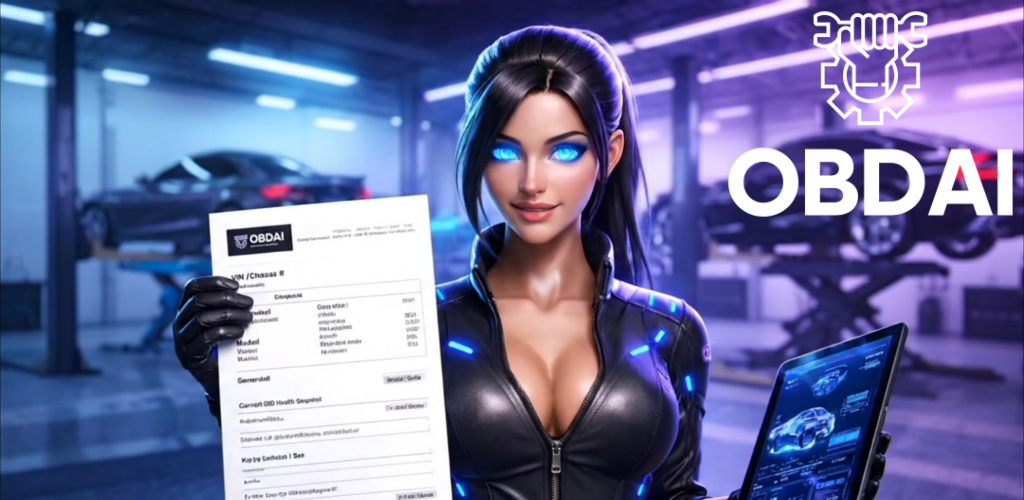
This is a real ARIA report from a 2011 Ford Ranger pre-purchase inspection. ARIA caught recently cleared codes, flagged a failing catalytic converter, estimated $1,000+ in repairs, and told the buyer exactly how to negotiate. Try getting that from a $15 code reader.
ARIA now generates professional PDF diagnostic reports from any conversation. Not a screenshot. Not a copy-paste job. A branded, formatted document with your vehicle information, diagnostic findings, and recommendations — ready to print, email, or hand to a customer.
One tap. That’s it.
Every response ARIA gives you is written in structured markdown behind the scenes. When you tap the report button, OBDAI sends that markdown to our Azure cloud service, which converts it into a professionally formatted PDF with OBDAI branding, vehicle identification, and a clean layout that looks like it came from a diagnostic shop — because it did.
Here’s what makes this different from exporting a chat log: you control what goes into the report by controlling the conversation.
ARIA doesn’t generate a fixed template. She generates whatever you ask for. The report is the conversation. So if you want a pre-purchase inspection report, you have a pre-purchase inspection conversation. If you want a repair estimate, you have a repair estimate conversation. If you want a simple code explanation to hand to a customer, you ask ARIA to explain the code simply.
The PDF engine doesn’t care what the content is. It takes markdown — headings, tables, bullet points, bold text, code blocks — and renders it into a professional document with consistent typography, OBDAI’s purple brand header, vehicle VIN and identification, and a clean footer. Every report says “Powered by ARIA — Automotive Reasoning & Intelligence Agent” on page one.
Let’s be direct about it.
You’re already doing the diagnostic work. You’re already plugging in, reading codes, analyzing data, explaining what’s wrong. You’re doing $150 worth of work and charging $75 for it — because without documentation, the customer thinks you just plugged in a little tool and read a screen.
The report changes the perceived value of what you do. A printed document with their VIN, findings, and recommendations turns “he told me it was the thermostat” into “here’s the diagnostic assessment.” One is a verbal opinion. The other is a professional service. Customers pay more for professional services.
Here’s the math that should keep you up at night:
And that’s before we talk about the estimate. Because when the report includes parts pricing, labor breakdown, and a total — that’s not a diagnostic anymore. That’s a quote. A professional quote that the customer takes home, shows their husband or wife, and calls you back to approve. You just shortened your sales cycle from “let me think about it” to “here’s what it costs, sign here.”
OBDAI Premium costs $9.99/month. You make that back on the price increase from your very first diagnostic of the month. Everything after that is profit.
This is where it gets interesting for shops and mobile mechanics.
Imagine you just scanned a customer’s 2017 Ford Explorer. ARIA found a P0128 (coolant thermostat below regulating temperature), the coolant temp sensor is reading 158°F after a 20-minute drive, and short-term fuel trim is running rich at +8.2%. Here’s how you build a customer-ready estimate — just by talking:
That’s it. Five steps. You just produced a professional car diagnostic report PDF that Mrs. Johnson can read, understand, show her husband, and call you back to approve. Not a screenshot of a chat. A real deliverable that justifies your fee.
And you can do this for every single diagnostic. Every customer. Every vehicle. The workflow is the same — only the conversation changes.
Every PDF report includes:
Branded header — OBDAI’s purple gradient header with logo and “Powered by ARIA” designation. This isn’t a generic export — it’s authored by an AI diagnostic agent, and the report says so.
Vehicle identification — VIN, year, make, and model pulled from your scan session. ARIA decodes the VIN automatically using the NHTSA VPIC database (US vehicles) or the European VIN decoder for imports, so the report shows the exact vehicle — not just “customer’s car.”
Your conversation, formatted — Whatever ARIA wrote in response to your questions becomes the body of the report. Tables render as proper tables. Headings create section breaks. Bold text stays bold. Code references format cleanly. Markdown was designed for exactly this kind of structured document generation.
Professional typography — Segoe UI font, purple-branded headings matching OBDAI’s design language, zebra-striped tables, properly spaced sections. The report looks like it was designed, not generated.
Footer with disclaimer — “Generated by OBDAI • Ontario Analytics LLC” with a standard informational disclaimer. Professional and legally appropriate.

Page 2 of the same Ranger report. Repair cost breakdowns by component, negotiation strategy, and a specific action plan — all generated from a single conversation with ARIA while connected to the vehicle.
Here are some reports ARIA can generate right now — just by having the right conversation:
Pre-purchase inspection: Connect OBDAI to a vehicle you’re considering buying. Let ARIA scan everything — codes, readiness monitors, sensor data, freeze frame. Ask her “Give me a complete pre-purchase inspection summary with any concerns.” Tap the report button. Hand it to the seller, your mechanic, or keep it for your records.
Customer diagnostic report: You’re a mobile mechanic who needs OBD2 diagnostic reports for every job. You just diagnosed a misfire on cylinder 3. Ask ARIA to “Write up a diagnostic report for my customer explaining what we found, what needs to be fixed, and the estimated cost.” Include your labor rate, parts pricing, and ARIA builds the document. Professional enough to justify your diagnostic fee.
Fleet maintenance log: You manage a fleet of work trucks. Scan each vehicle weekly with OBDAI. Ask ARIA to summarize the scan and flag any developing issues. Export the report. Drop it in the vehicle’s maintenance file — or pull it up later in the web dashboard where your entire scan history lives. You now have AI-generated diagnostic documentation for every vehicle in your fleet.
Emissions prep report: Customer needs to pass smog. Scan with OBDAI, check readiness monitors, review any pending codes. Ask ARIA “Is this vehicle ready for emissions testing? What monitors are incomplete and what needs to be done?” Export the report. Either hand it to the customer as a clean bill of health, or as documentation of what needs to be addressed first.
Repair estimate: The Mrs. Johnson example above. Diagnostic findings, parts with pricing, labor estimate, professional tone, personal touch. A document your customer can take home, show their spouse, and call you back to approve the work.

A drive test report from a 2017 Ford Explorer. ARIA analyzed fuel trims across operating conditions, profiled catalyst temperatures at highway speed, and rendered a summary table showing speed, load, fuel trim, and catalyst temp at representative points during the drive. This is the kind of documentation that turns a $75 scan into a $150 vehicle health assessment.
For the technically curious — and if you’re shopping for an AI OBD2 scanner with PDF reports, this is the kind of engineering that separates a real tool from a gimmick — here’s what’s happening behind the scenes. The PDF generation system runs as an Azure Function on Linux, using Syncfusion’s Blink rendering engine (headless Chromium) to convert styled HTML into pixel-perfect PDFs:
The vehicle metadata (VIN, year, make, model) populates the report header automatically from your scan session. The AI model — GPT-5.1 for Premium subscribers — produces markdown with full awareness that the output will be rendered as a document, so it naturally structures responses with appropriate headings, tables, and formatting.
The entire conversion takes 3-5 seconds on a warm server. First request of the day takes about 15-20 seconds while the rendering engine initializes — then it’s fast for every report after that.
There are two categories of automotive AI tools now.
The first category reads a code, runs it through ChatGPT, and shows you a paragraph of text on your phone screen. That’s where every other “AI scanner” lives. The text disappears when you close the app. You can’t hand it to anyone. It’s a conversation with a chatbot.
The second category produces professional deliverables. Documents with vehicle identification, diagnostic findings, repair recommendations, and cost estimates — authored by an AI agent that actually analyzed your vehicle’s live data before writing the report. Documents you can hand to a customer, attach to a work order, or file for your records.
OBDAI with ARIA is the only product in the second category.
If you’re already an OBDAI Premium subscriber, you have this right now. Connect your dongle, scan a vehicle, talk to ARIA, and tap the export button. Your first professional diagnostic report is one conversation away. Your first price increase is one report away.
If you’re not a subscriber yet, OBDAI hardware bundles start at $99.99 — the Bluetooth dongle, one year of Premium with ARIA and PDF report generation, and access to the web dashboard where your entire diagnostic history lives. You’ll make that back on your first diagnostic with a report attached. Everything after that is margin.
And if you’re a shop owner or mobile mechanic who wants your logo on every report — OBDAI PRO is coming soon with unlimited reports, custom branding, and professional tools built for turning scans into billable deliverables. Your shop name. Your phone number. Your logo. On a document authored by an AI diagnostic agent. That’s not a scan tool anymore — that’s a revenue stream.
OBDAI Premium includes PDF diagnostic report generation on iOS, Android, and Windows. Get OBDAI →
